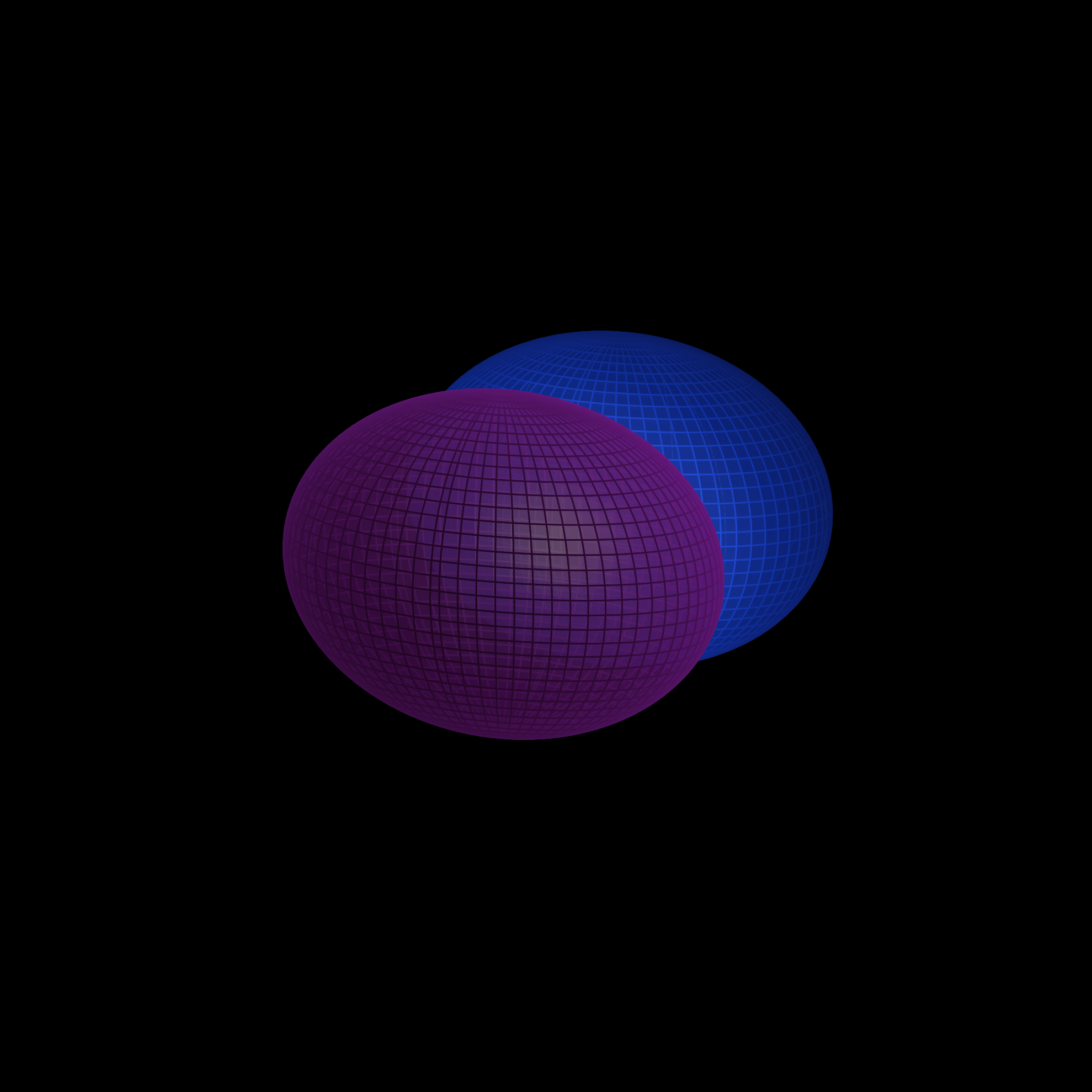
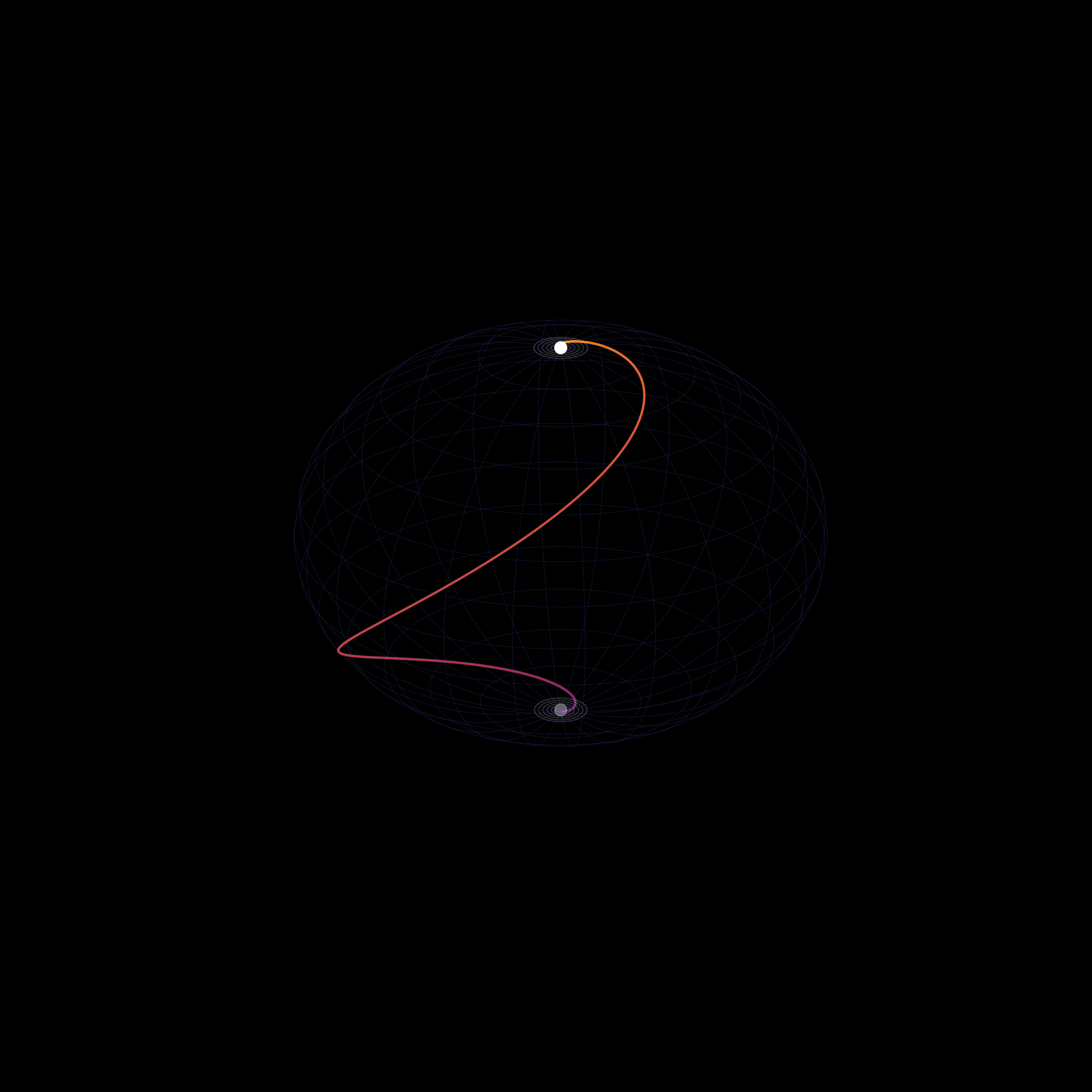
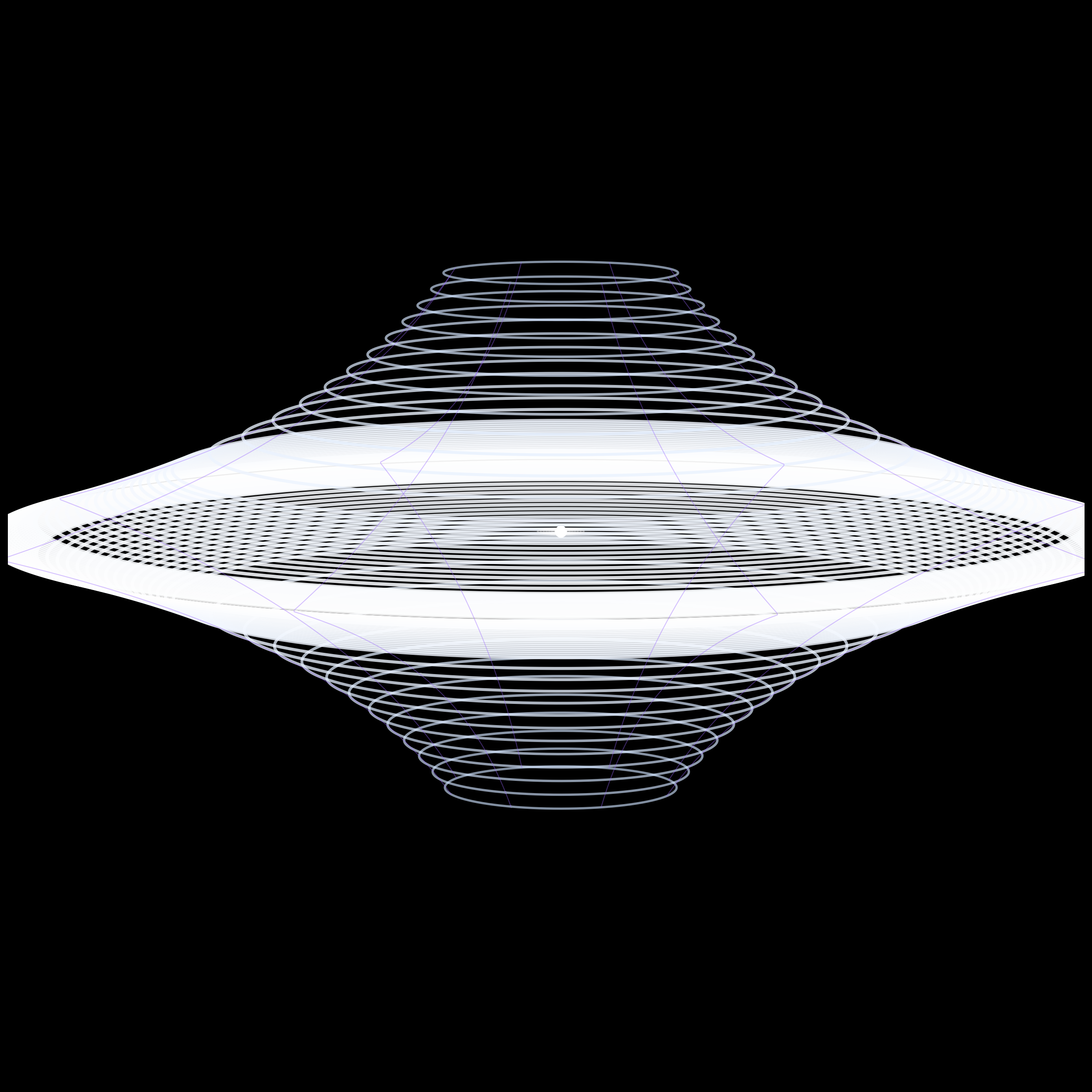
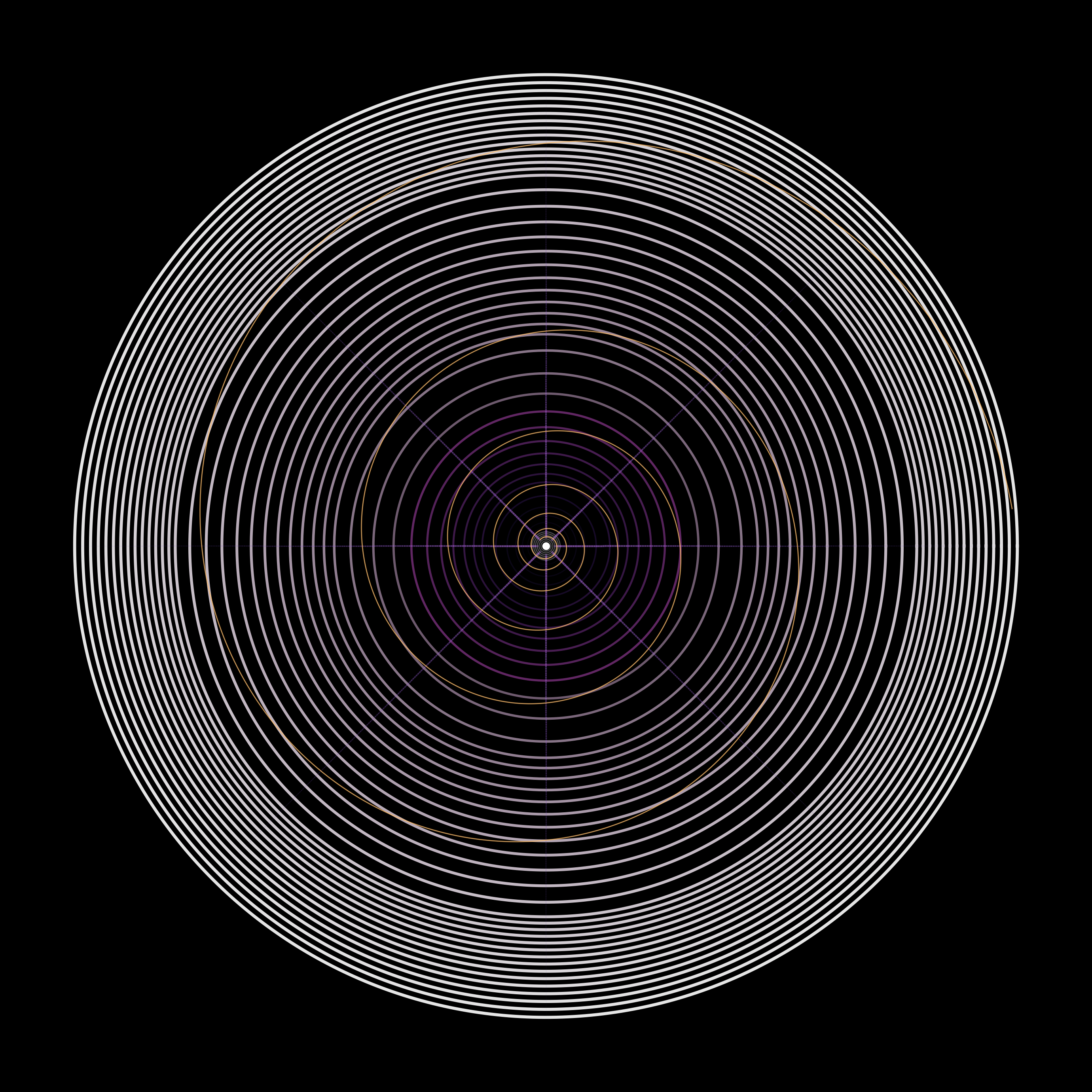
A warped extra-dimension model on $I \times (S^2 \!\vee\! S^2)$ with $\mathbb{Z}_8$ holonomy. From particle physics to the genetic code—one geometry, one axiom, two papers.
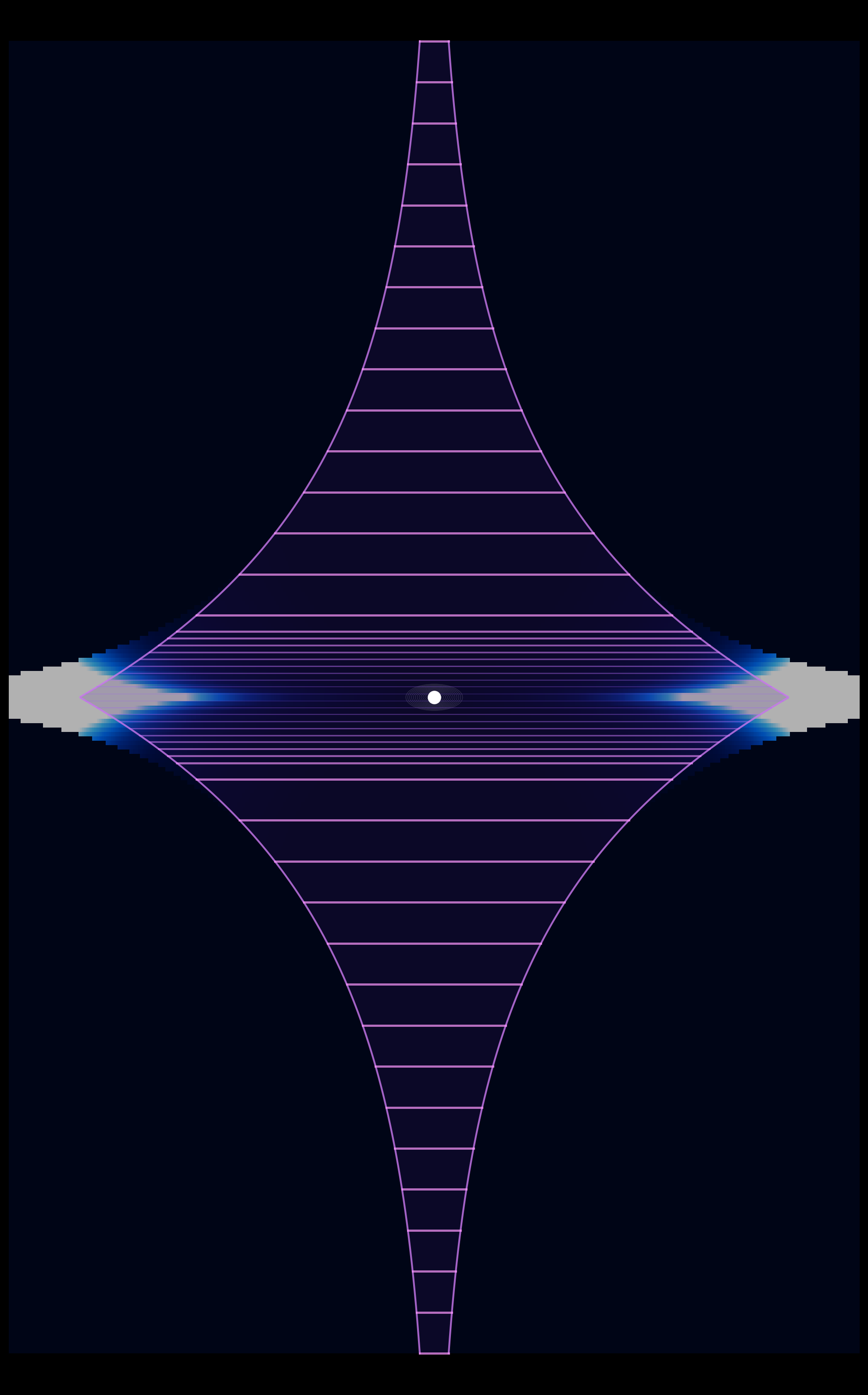
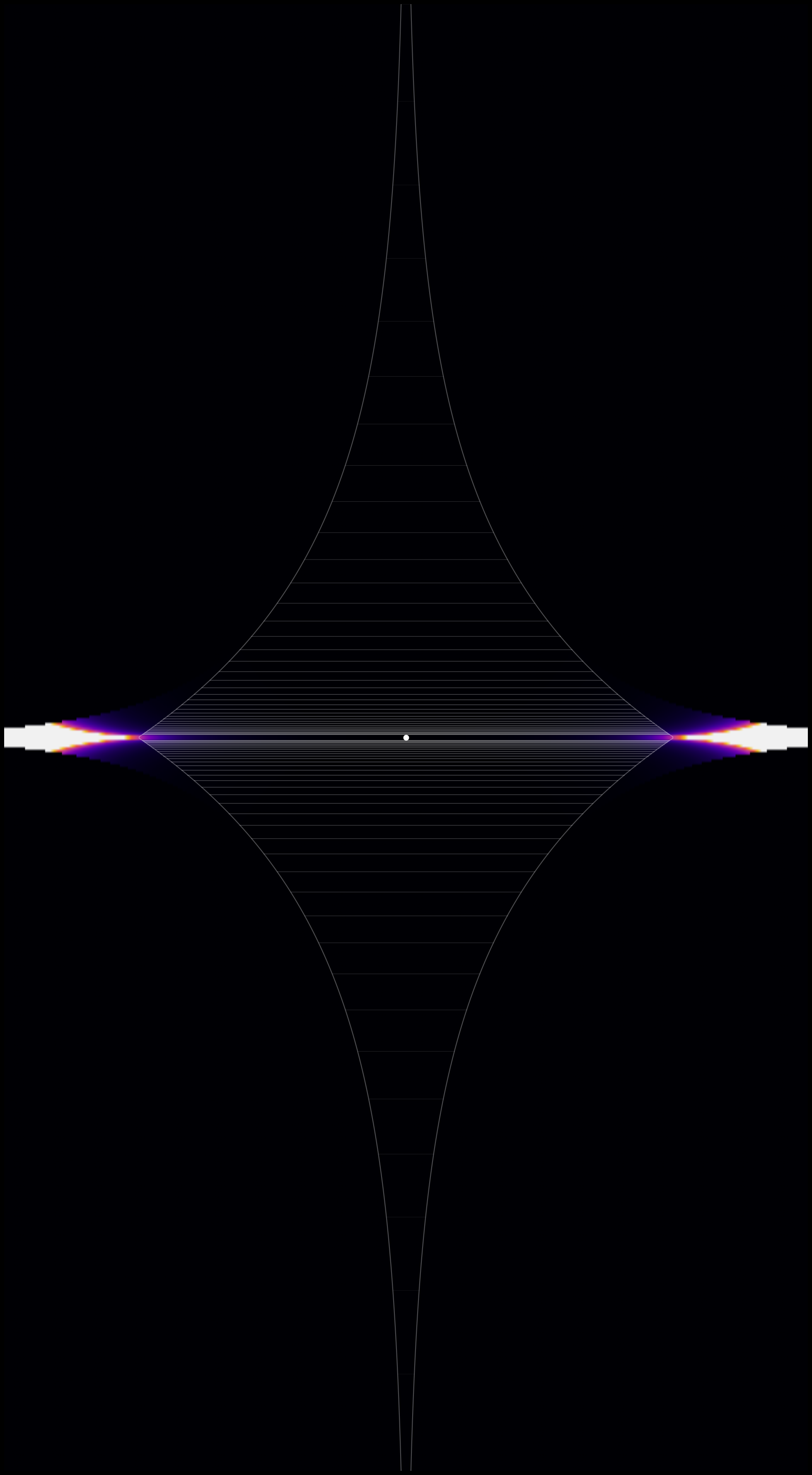
The spacetime has topology $I \times (S^2 \!\vee\! S^2)$, where $I = [0, L]$ is a warped interval and $S^2 \!\vee\! S^2$ is the wedge sum of two two-spheres joined at a single junction point. This extends Randall–Sundrum from $I \times \mathbb{R}^3$ to a compact internal space carrying discrete $\mathbb{Z}_8$ holonomy.
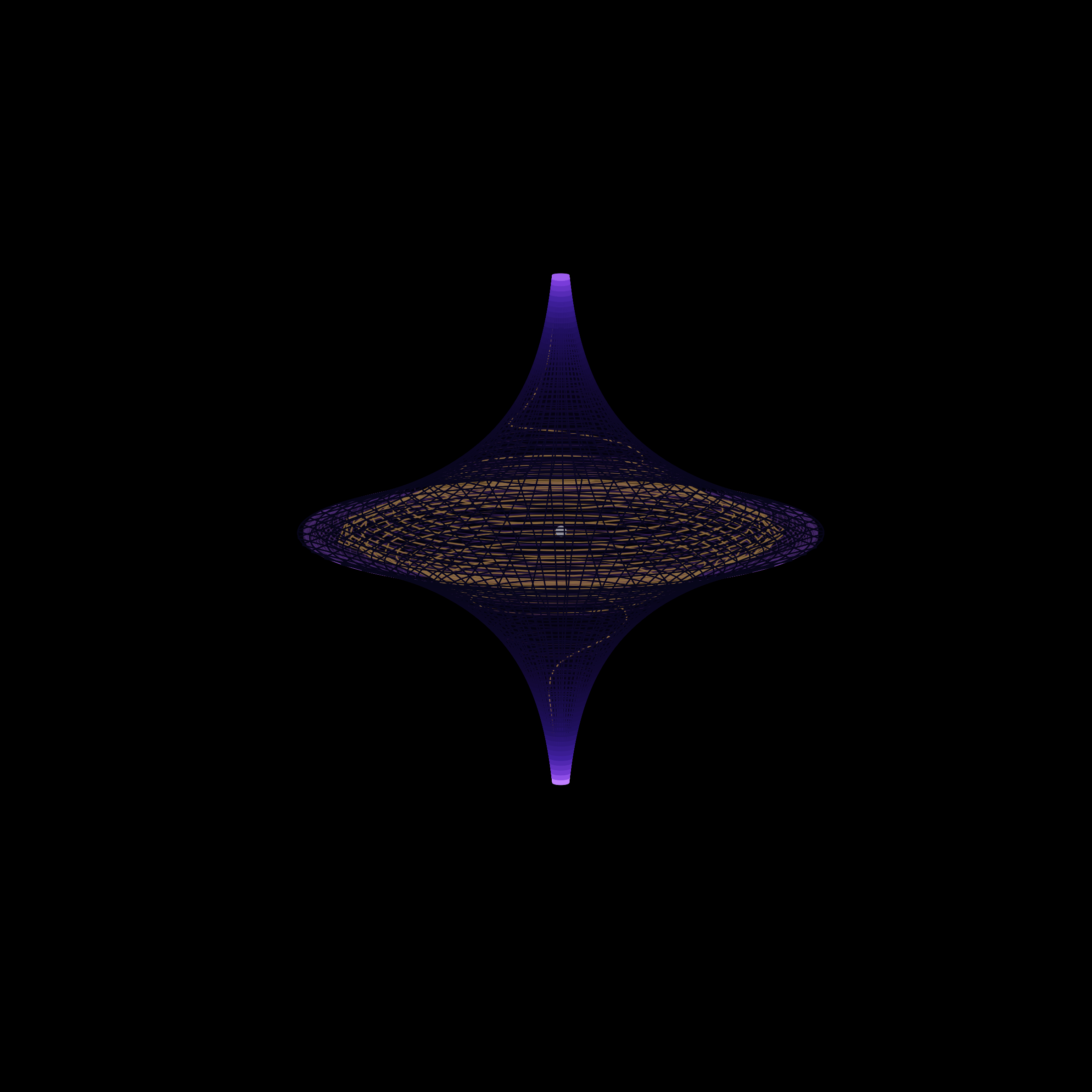
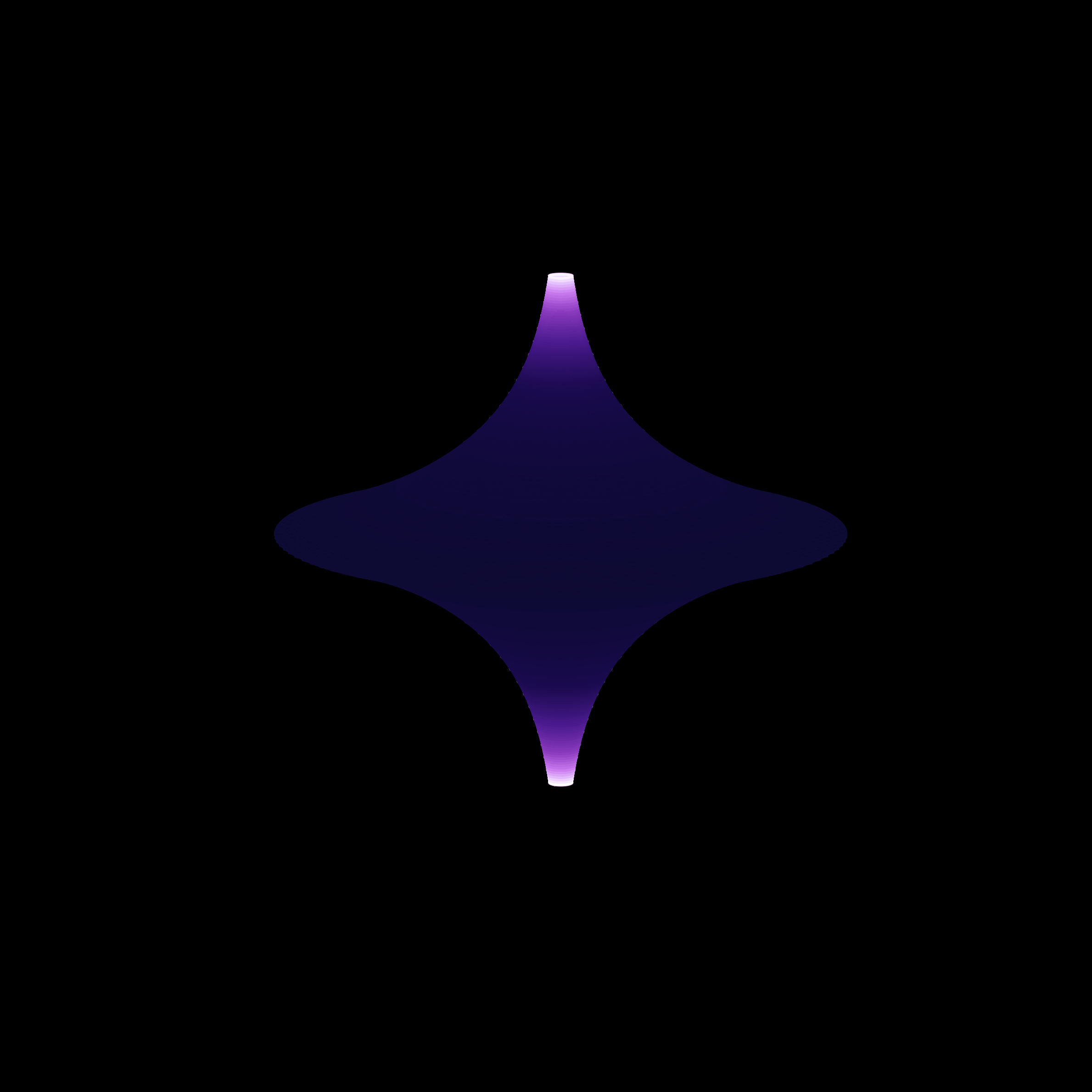
The warp factor $e^{-kz}$ applies to all four noncompact dimensions—including the $S^2$ angles. This fully warped funnel is the unique self-consistent geometry: the cylinder ($S^2$ unwarped) has zero GW friction and a phantom warp parameter. Only the funnel supports Goldberger–Wise stabilization.
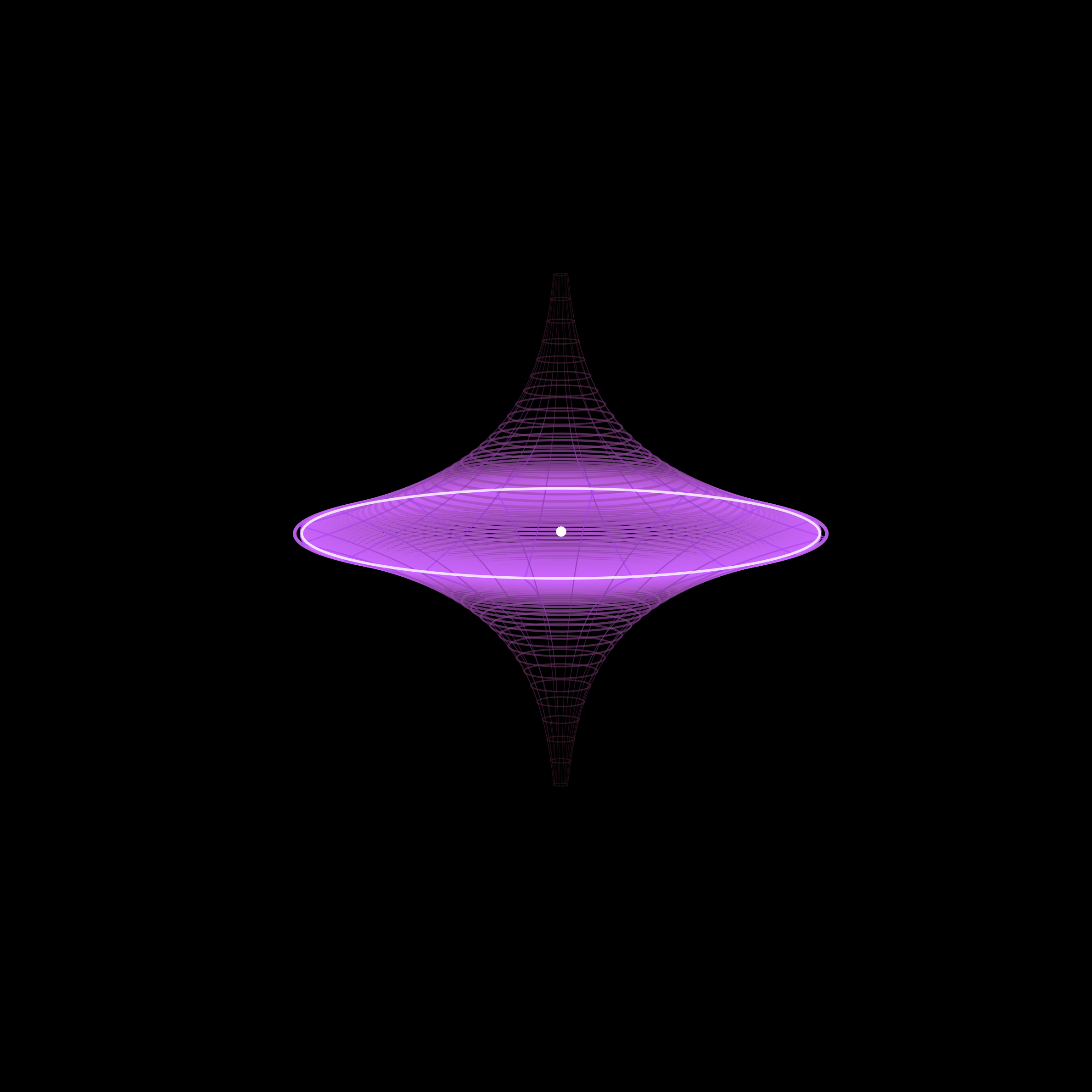
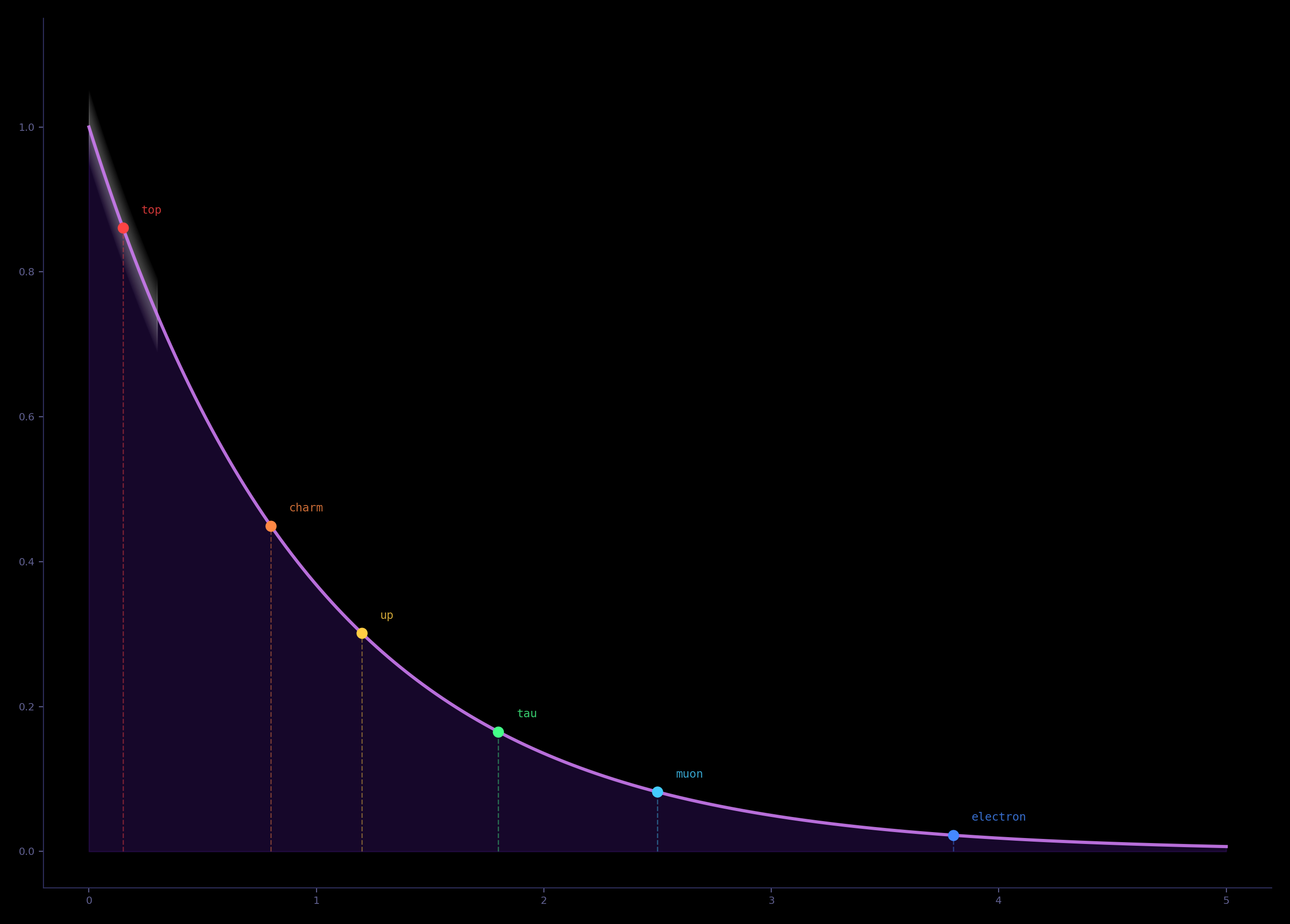
The $\mathbb{Z}_8$ holonomy assigns angular momentum $\ell = 1, 2, 3$ to three generation pairs. Each mode stabilizes at a different funnel length via the Goldberger–Wise mechanism. The $\mathbb{Z}_4$ subgroup chain provides a non-monotonic perturbation that extends to quarks.
| Particle | Predicted | Observed | Error | Class |
|---|---|---|---|---|
| Electron | 0.5125 MeV | 0.5110 MeV | 0.29% | D |
| Muon | anchor | 105.66 MeV | — | A |
| Tau | anchor | 1776.9 MeV | — | A |
| Up | 2.23 MeV | 2.16 MeV | 3.36% | D |
| Charm | anchor | 1270 MeV | — | A |
| Top | 171,387 MeV | 172,760 MeV | 0.79% | D |
| Down | 4.52 MeV | 4.67 MeV | 3.12% | D |
| Strange | anchor | 93.4 MeV | — | A |
| Bottom | 4161 MeV | 4180 MeV | 0.45% | D |
Six predictions spanning five orders of magnitude (0.5 MeV to 173 GeV). Average error: 1.44%. Single free parameter: $\epsilon_0 = e^{-50\delta_0} = 1.437 \times 10^{-3}$ (derived from mode counting). D = Derived F = Fit (derivation pending) A = Anchor (experimental input)
| Constant | Formula | Predicted | Observed | Error | Class |
|---|---|---|---|---|---|
| Fine structure | $1/\alpha = 4\pi^3 + \pi^2 + \pi$ | 137.036 | 137.036 | 0.0002% | F |
| Proton/electron | $m_p/m_e = 6\pi^5$ | 1836.12 | 1836.15 | 0.0015% | F |
| Weinberg angle | $\sin^2\!\theta_W = \pi/(4\pi+1)$ | 0.2316 | 0.2312 | 0.15% | F |
| Strong coupling | $1/\alpha_s = 3\pi - 1$ | 8.425 | 8.482 | 0.67% | F |
| Higgs mass | $m_H = v_{\text{EW}}\sqrt{\pi/12}$ | 125.98 GeV | 125.25 GeV | 0.58% | D |
| Higgs quartic | $\lambda_H = \delta_0 = \pi/24$ | 0.1309 | 0.1294 | 1.16% | D |
| $m_H / m_W$ | $\pi/2$ | 1.5708 | 1.558 | 0.80% | D |
Class F constants have look-elsewhere penalties computed: $1/\alpha$ polynomial search over 5.2M candidates yields 22.3 bits information gain. Suggestive but not yet derived from first principles.
Neutrinos follow the same GW mechanism with two modifications forced by zero electric charge: spinor (half-integer) angular barriers and double-sphere propagation.
| Observable | Predicted | Experimental | Status |
|---|---|---|---|
| $\Delta m^2_{31}/\Delta m^2_{21}$ | 32.6 | 32.6 | 1.45% on $\delta_0$ |
| $m_1$ | 1.15 meV | — | prediction |
| $m_2$ | 8.75 meV | — | prediction |
| $m_3$ | 49.5 meV | — | prediction |
| $\sum m_i$ | 59 meV | $< 120$ meV | consistent |
| Ordering | normal | normal | confirmed |
The factor $6 = 2 \times 3$ = (sphere doubling) $\times$ (Euler characteristic). Depends on no parameter whatsoever.
Current best fit: $\sin\delta \approx -1$ (~$270^\circ$). This is the hardest test of the model. If DUNE measures $\sin(\delta_{\text{PMNS}}) < 0$ with $> 3\sigma$, this prediction is falsified.
The $\ell = 0$ junction mode on $S^2 \!\vee\! S^2$ falls at 1.37 eV—the covalent bond energy scale. The same $\mathbb{Z}_8$ holonomy that generates the particle spectrum reproduces the combinatorial architecture of the genetic code. No additional parameters.
| $\mathbb{Z}_8$ Feature | Value | Genetic Code | Class |
|---|---|---|---|
| $\varphi(8)$ generators | 4 | DNA bases | D |
| Sectors at junction | 3 | Codon positions | D |
| Ordered triples $4^3$ | 64 | Total codons | D |
| $\binom{6}{3}$ multisets | 20 | Amino acids | D |
| $\text{Aut}(\mathbb{Z}_8)$ orbits | 5 | Degeneracy classes | D |
Stage 1 — Phase interference:
$|e^{i\phi_{j_1}} + e^{i\phi_{j_2}}|^2$ eliminates destructive pairs $(1,5)$ and $(3,7)$.
Stage 2 — Holonomy closure:
$j_1 + j_2 \equiv 0 \pmod{8}$ selects exactly $\{1,7\} = A\text{-}T$ and $\{3,5\} = G\text{-}C$.
| Pair | Interference | Closure | Classification |
|---|---|---|---|
| (1,7) = A-T | Constructive | Closed | Watson–Crick |
| (3,5) = G-C | Constructive | Closed | Watson–Crick |
| (1,3) | Constructive | Open | Mispair |
| (5,7) | Constructive | Open | Mispair |
| (1,5) | Destructive | Open | Forbidden |
| (3,7) | Destructive | Open | Forbidden |
$\mathbb{Z}_8^* \cong V_4 = \mathbb{Z}_2 \times \mathbb{Z}_2$ has exactly 3 non-trivial involutions. Biology uses all three. No further involutions exist.
| Involution | Map | Orbits | Biological Function |
|---|---|---|---|
| $I_7$ | $j \to 7j$ | $\{1,7\},\{3,5\}$ | Watson–Crick pairing |
| $I_5$ | $j \to 5j$ | $\{1,5\},\{3,7\}$ | Wobble degeneracy |
| $I_3$ | $j \to 3j$ | $\{1,3\},\{5,7\}$ | Position-2 dominance |
The 3 six-fold amino acids (Leu, Arg, Ser) correspond 1-to-1 to the 3 involutions. Serine uniquely crosses the purine/pyrimidine divide, requiring full charge conjugation ($I_7$) on both positions.
$n = 3$ is the smallest odd $n$ giving sufficient combinatorial richness ($4^3 = 64$ codons). The reading frame is a $\mathbb{Z}_8$ arithmetic inevitability.
The antiparallel double helix is the unique stable periodic configuration on $S^2 \!\vee\! S^2$ with $\mathbb{Z}_8$ holonomy. Proved by elimination in five lemmas:
The single irreducible axiom $v = \pi^2$ decomposes into three geometric ingredients:
The identity $\delta_0 = \pi/24 = \zeta(2)/(4\pi)$ encodes the Riemann zeta function directly in the isotropy parameter. The key physical postulate is that junction dynamics collapse onto the loxodrome (1D reduction).
Explore the funnel geometry and double helix in your browser. Drag to rotate, scroll to zoom.
Every quantitative result is classified. Nothing is hidden.
8 pages, PRD format. Fermion masses, coupling constants, mixing angles, neutrino sector.
6 pages, PRD format. DNA bases, codon structure, three involutions, double helix uniqueness theorem.
Developed with AI-assisted computation and verification (Claude/Anthropic, Gemini/Google DeepMind, Codex/OpenAI, Grok/xAI).